


What factors separate a difficult sport from the hardest sport? The debate over the hardest sports is an ongoing battle, and students at Morgan have opinions of their own.
I asked several students at Morgan their opinion on what they thought the hardest sport at Morgan was. I asked kids from all different sports, boys and girls, and got many different answers. I will be judging the difficulty of the sport based on physical demand, technical skill, and tactical skill.
For the physical aspect, I will analyze things like the preseason preparation, the size of the playing field, and the rules of the game. For the technical aspect, I will look at the skills required within the sport. Lastly, I will judge it by the tactical understanding needed, evaluating a player’s necessity to read the game, make quick decisions, and apply strategic plans.
The Public Opinion:
The public opinion was hockey. 75% (6/8) of the people I asked said hockey. Many students reasoned that it was the most difficult because you have to not only learn to skate, but also play while skating. It is also a very physical game.
Senior, Addy Reed is a multi-sport athlete. She has been involved in Morgan athletics all four years, playing track, soccer and basketball.
“I think hockey is the hardest sport at Morgan because not only do you have to have the coordination to be able to hit a puck around a rink of ice, but you also have to be on ice skates the whole time, which alone is really hard. It’s also very fast-paced and aggressive.”
Senior, Braedan Stheale, who has been a member of the co-op hockey team all four years of high school also agreed with Reed.
“I think the hardest sport at Morgan is hockey because it is a very agile sport with the skating and physicality; you have to be fast, be able to hit, have good coordination, and it just requires a lot of skill.”
When looking at hockey technically, you need elite skating ability and precise stick skills. Skills involve controlling the puck’s stability, using proper weight transfer for shots, and managing your momentum for quick turns and feints.
Technical skill and speed/quickness are rated as the most important factors for success in elite hockey. Players must balance on 1-inch blades and possess good hand-eye coordination for shooting and passing. Players must react to pucks moving over 100 mph at a professional level.
The game is also difficult physically because you need to be well-conditioned. There are often rapid, intermittent 30-80 second shifts, which cause you to have to constantly skate on and off the ice. These shifts on average, cause your heart rate to rise above 85% of your maximum, particularly for defense-men. This differs from basketball and soccer, as in these sports, players spend most of their time in the 70-80 range.
“Hockey is so stamina demanding because every shift is basically a full sprint on skates while battling through contact, changing direction, and keeping your head on a swivel to avoid getting hit. Players go all out for 45-60 second shifts because the combination of speed, physicality, and contact awareness burns energy faster than almost any other sport”, said Stheale.
Specifically, on the co-op team that the Morgan students play for, they have off-ice conditioning three times a week. During these conditioning sessions, they do things such as push ups and squats. On top of physical conditioning, they have to manage high-impact collisions. The surfaces are unforgiving, and players often get slammed into the walls. The collisions are 17% harder than football, as determined by ESPN’s sport science, and the surface of the ice is much less forgiving than the grass.
Due to the fast pace of the game, the players also have pressure to make split-second decisions. This is the tactical part of the game. There are many defensive tactics they have to be on top of, such as a 1-3-1 trap, managing gaps, and boxing out players so they can’t be in a high scoring slot area. They also have to tactically limit opposing speed and force turnovers by using traps such as the bow tie trap, which is a figure-eight pattern meant to force turnovers and start a 3 on 1 attack. Overall, hockey is a very difficult sport in all the three focus areas, physically, technically, and tactically.
Runners-up: Wrestling
Other than hockey, students also answered with wrestling. Senior Kate Gardner is a well-rounded athlete. She has been involved with Morgan girls soccer all four years in high school and played tennis the last two years.
“I think wrestling is the hardest sport because it’s really intense physically, and you’re also by yourself, so it is isolating.”

Wrestling requires extreme physical exertion. Wrestlers often maintain only 7-10 percent body fat and experience high injury rates, ranging from 2-30 per 1,000 matches or practices, as the organization Active & Safe reported.
Wrestling relies strongly on the anaerobic system. They need to have high intensity for short durations, requiring quick recoveries in between high intensity bursts. Roughly 45.8 percent of wrestlers sustain an injury within a six-month period, with 52.5 percent having chronic injury issues. The Morgan wrestling team prepares for this physical aspect through repetition at practice.
Junior, Pedro Reis stated, “We spend a lot of time just in our stance of motion and shooting and sprawling, and the coach prolongs the time so it just takes everyone out and is exhausting.”
When looking at the technical aspect, 62.6% of matches are won on technical points. Technical points are the active points a wrestler scores during a match through offensive moves or defensive action. Some technical moves include the take down and a reversal. A take down is worth two points and occurs when the opponent is taken down to the mat and controlled. A reversal is then worth two points and is when a player moves from a defensive and bottom position to an offensive and top position. Technique is so important because it helps a player overcome strength disparities, conserve energy, and perform moves with the greatest efficiency.
The tactical aspect is what helps the wrestlers outsmart their opponents and win the match. Athletes who execute the correct techniques at the right time have over an 80 percent success rate compared to losers, according to a study on wrestling kinetics done by United World Wrestling Academy.
They must have good match management and pacing. The wrestler who takes the center of the mat usually controls the match and avoids penalties for stalling. They have to know when to hold a 1-point lead and when to aggressively pursue a pin. There are many different take down or neutral tactics to the game such as fake shots, pushing/pulling, proper hand movements, and utilizing positioning to block shots.
Runners-up: Soccer
The only other sport that was mentioned through the several interviews was soccer. Senior Andrew Randi has played soccer all four years at Morgan.
“I believe soccer is the hardest sport at Morgan, specifically because the standard is so high. With so much success on the boys and girls teams in the past, there is a lot of pressure to perform and win for both teams,” said Randi.
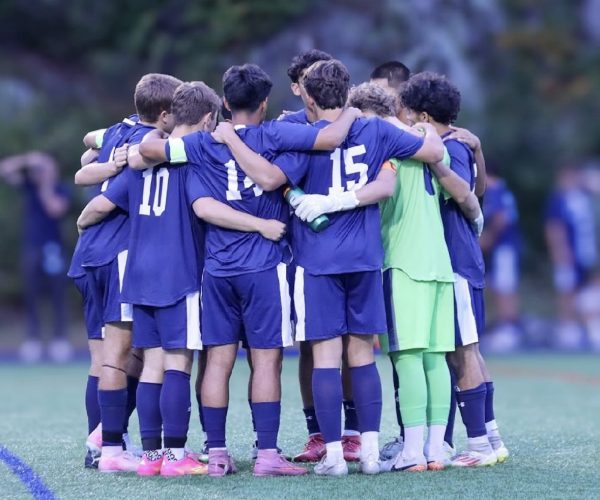
Physically, the Morgan boys’ soccer team prepares for the season with a ton of fitness. They start in the beginning of July, and run two miles twice a week. They then follow the running with physical body workouts such as pushups. They keep progressing and then do 3 miles for two weeks after these first couple of weeks, and then progress into practicing 4 days a week with two .
The two miles is not a test that stays in preseason; they consistently run two miles throughout the season and their times would be tracked to see if they were improving. The freshmen would have to get under 14 minutes, the sophomores under 13.30, the juniors under 13, and the seniors under 12.45. Although not as rigorous, the Morgan girls’ soccer team also has preseason fitness requirements.
During preseason, they must do a three-mile run. This is not for time, but they are encouraged to work as hard as they can and run the entire time. Throughout the season, they incorporate their fitness through drills. During a full game, high school players often run 4 to 7 miles per game, enduring a combination of high-intensity sprinting, constant jogging, and rapid changes in speed and direction.
Soccer is highly technical because it requires precise and consistent ball control while players are under extreme physical fatigue. This sport also requires quick decision-making when under pressure. Using feet for fine motor skills goes against natural human development, as we rely on our hands for almost everything. Controlling a fast pass, playing it accurately to a moving teammate, or shooting in a specific place requires exceptional hand-eye coordination and a lot of practice. Furthermore, a player must not only use their feet but different areas of their body as well to trap or manipulate the ball, including their chest and thighs to settle a ball out of the air.
A player must also have precision when passing and shooting. Hitting the ball slightly off center changes the spin, trajectory, and power of a kick. Players must change their technique on the fly if executing different kicks such as chipping the ball, curving it around defenders, or striking the ball for power. Lastly, a player must be able to dribble under pressure. They must keep the ball glued to their feet, taking quick, small touches to change direction, trick defenders, and maintain balance.
Tactically, the team must constantly maintain its shape and work together to control the game. Soccer is a very fluid game, and if one player makes a run and gets out of position, someone has to move and cover for them or else it will leave a gap in their formation and hurt them defensively. Unlike other sports, there are no timeouts or play calling so the coach doesn’t have as big of an impact on the game. It is on the players to read the game and make split second decisions to gain advantages and win the game. They must use different passing combinations and off the ball movement to break down the team’s defense. Defensively, many teams implement different pressing techniques and positioning to eliminate gaps and force turnovers. Some teams prefer a more compact technique where they will all bunch into the middle and give their opponents time, forcing them to dribble or play in long. Other teams prefer a high press method where the forwards are instantly pressuring the ball and forcing them one way, with the rest of the team pushing up right behind them.
Players must also demonstrate an understanding of spatial awareness. With the size of the field, there are always gaps in the opponents defense depending on their formation. For example, if the other team was playing a 3-5-2, the gaps would be on the outsides as they don’t have any outside backs. Players must read the other teams formation and figure out where these gaps are and where to make runs into.
Overall, based on physicality, technical skill, and tactical skill hockey is the hardest sport at Morgan. It combines the explosive burst energy of wrestling with the relentless endurance of soccer. Unlike soccer and wrestling, on top of handling the puck, they balance on the ice in skates with razor thin blades. It is harder physically due to the unforgiving surface, hyper-intense bursts, and full-body armored contact. It’s harder technically as a player must multitask on the ice, balancing oneself, propelling oneself, and dodging checks, all while using a stick to handle the puck. This differs from soccer as one controls the ball with their feet, and also wrestling where one manages their own body weight and their opponent. Lastly, it is hardest tactically because the players are constantly shifting, getting replaced on the fly and causing the players to constantly adapt to new teammates, new opponents, and evolving game states. The split-second processing also makes it the hardest tactically because the rapid pace of the game leaves little time to think. Players must read their opponents defensive alignments, anticipate their opponents movements, and find passing angels at much higher velocities than in soccer. In conclusion, hockey is overall the hardest sport at Morgan physically, technically, and tactically.
