
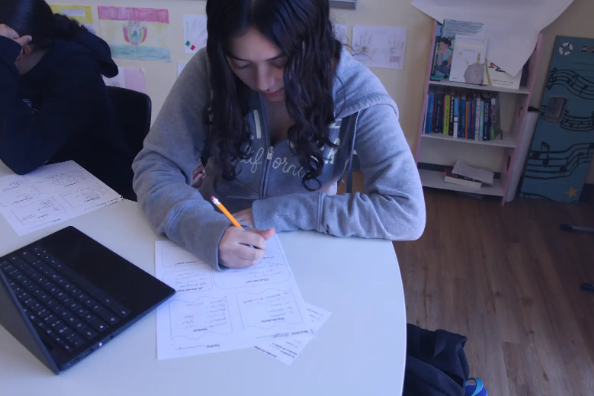
Morgan Hoover, a freshman here at The Morgan School, is in four honors classes. Outside of school, she has clarinet as well as singing lessons, participates in a singing group, and also is a part of a soccer club. Her commitments take up five days of the week, both after school and on the weekend.
Each day after her extracurricular activities, she gets home and starts her homework. For Hoover, it often becomes a dreadful experience, as she spends hours completing assignment after assignment. Many nights, a break, to spend time with family or friends or to find a new hobby, becomes unrealistic. Instead, her time is spent solely on schoolwork until the moment she goes to bed. Many students find themselves in such a situation, especially when in multiple honors classes. This has led to rising concerns regarding the workload students receive, particularly for homework.
During the COVID-19 pandemic, students began remote learning. The increased use of online tools during that time had a lasting impact on what is used today. “The pandemic brought with it the advent of strategies like “flipped learning”, which relies heavily on homework as an integral component of the lesson. While this might work for some, many students grew weary of the reliance on homework during remote and hybrid learning,” wrote Marina Whiteleather in an article for EducationWeek in 2022.
Flipped learning is when students learn new concepts at home by video or textbook assignments.
During the pandemic, students would do this on their own and then during the online meets would have a discussion about what they learned. When they returned to school, this tactic was still used, but rather than discussing on meets they would use the class time to do that. Since flipped learning was developed during the pandemic, the workload it would bring was not addressed because students were already doing all their work at home. While not used in every school, this reflects the larger shift in learning and homework brought about by the pandemic.
Hoover agrees, believing that the pandemic created different methods and a new standard for learning. For her, homework comes with a cost. She finds that it can be difficult to do it while maintaining a healthy sleep schedule. “I aim to go to bed by ten-thirty, but it usually doesn’t end up that way because of homework. So instead, I end up going to bed by twelve, meaning I only get about six hours of sleep,” said Hoover.
With the little rest she gets, Hoover has noticed that the quality of her schoolwork is degrading. “I lack focus and energy when I’m tired, so a lot of the time I don’t complete my homework with my best effort…I always end up doing it so late because the time we’re given to do assignments doesn’t match up with the workload.”
In an article for MercoPress from January this year, it is noted that “Students experiencing high workload often report difficulty concentrating, racing thoughts, and fear of falling behind. Over time, this can contribute to burnout, a state characterized by mental fatigue, reduced motivation, and a sense of detachment held from studies.”
Hoover’s experience directly demonstrates this since she highlights that “My attention span becomes less and less as I continue to work on assignments back to back.”
Another freshman, Estelle Giai, shares similar thoughts with Hoover. “I’m usually up till eleven or twelve doing homework…then I don’t get that much sleep which just impacts my mood and the way I work and interact with others too.”
Giai is part of the fencing team and softball team here at Morgan, and also participates in the musical. After practice or rehearsal, “I usually do about two hours of homework, but sometimes it even ends up being more than that depending on how much I have for each class,” said Giai.
When she has such a large amount of homework, Giai has noticed that she no longer cares about learning the material, but only has the desire to finish the assignments as quickly as possible. “When I also have many other commitments, it’s hard to really put effort into the work anymore. At this point, I’m not completing homework for the enjoyment of learning but just because I have to get it done. It really sucks the fun out of it because now homework just really stands for exhaustion,” said Giai.
The system regarding homework is seen as flawed in the eyes of many. In an article for EducationWeek, it was revealed in a poll taken in December 2025 that “while educators can see benefits to homework, many believe that the amount of homework that students have is too much.” One particular teacher decided a change was necessary, and made it happen.
Scott Anderson, a math teacher in Wisconsin, began his career giving about thirty problems to his students each night. At first this seemed like the right thing to do, but overtime he came to the realization that ‘“It wasn’t working. The kids weren’t learning; they were doing the problems wrong. Something had to change.”’
He began to lower the amount of problems, until homework was barely ever given out, causing it to go from “25 percent of a student’s grade to only 1 percent,” notes Tim Walker in an article for NEA Today.
Though it was a drastic drop, there have been proven benefits. ‘“We have been able to document the improvement of our student body moving roughly from 30 percent not ready for college math to almost 100 percent being ready,”’ said Anderson. With a change like this, the workload can be lowered while still giving students the education they need.
Should this happen, Giai finds that she would be able to apply herself more as the workload would be much more manageable. “If I didn’t have as much homework to do everyday, then I could use the time I have to put genuine effort into assignments instead of stressing about if I’m going to have enough time to do the next one,” Giai said.
Hoover and Giai both view homework as something that they need to be academically successful, but think that a change in how much they receive in each class would benefit their overall well-being and learning experience. Their insight reflects a shift in how students view academic success, indicating that homework should have a genuine purpose rather than simply being an expectation.