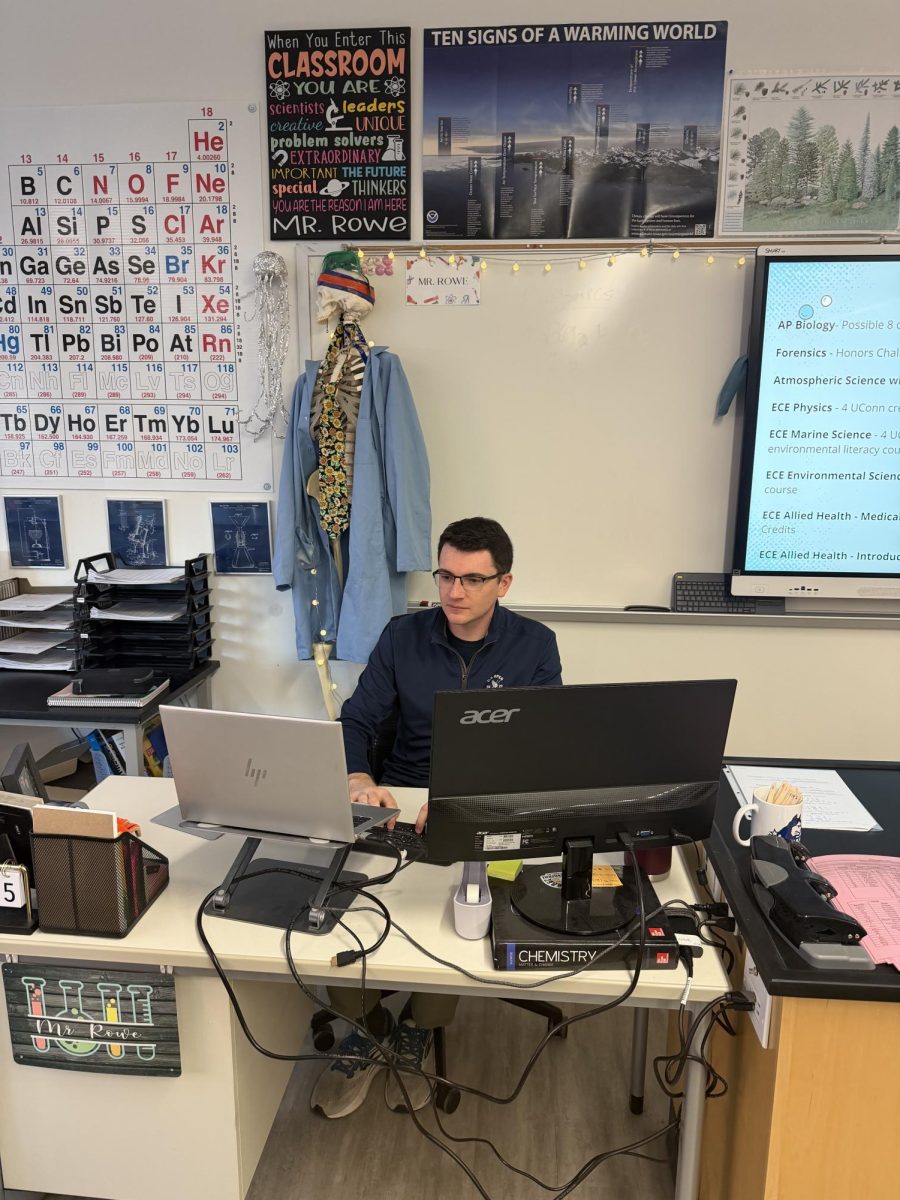
As artificial intelligence continues to grow in everyday life, it is also making its way into classrooms at Morgan. One teacher helping lead that shift is science teacher Jake Rowe, who has begun integrating Google’s AI tool, Gemini, into his lessons to support student learning rather than replace it.

Rowe explained that the idea to use Gemini came from professional development sessions in the spring of 2025 held by school administration. Teachers were introduced to different AI resources and encouraged to explore how they can be used responsibly for school. After experimenting with Gemini, Rowe began to see its potential.
“I first used Gemini in brainstorming some ideas of salt marsh restoration and the impacts of salt marsh loss in Connecticut. This helped me find some connecting points in the chemistry curriculum where I could introduce these concepts to students,” Rowe said.
From there, Rowe used Gemini behind the scenes to help design lessons. In chemistry, he wanted to connect chemical reactions to local salt marshes near Hammonasset, but he struggled to find a strong link. By using Gemini to brainstorm lesson ideas, he was able to create a multi day activity that connects chemistry to real world environments
“All it did was open the door,” Rowe said. “We still shaped the lesson, but it helped us get over that first hurdle.”
From there, Rowe saw the true potential it had for students. “Once I saw the ideas from it, it got me thinking about what students could leverage off of that,” Rowe said. “Not to replace learning, but to shape it in a different way.”
Although there are several AI platforms available, Rowe said he gravitated towards Gemini because of how well it integrates with Google classroom. This made it easier to tailor the tool directly to his lessons and materials. Rather than giving students generic responses, Gemini can be used to match the content grade level of each class.
In October, Rowe first introduced the use of AI in chemistry class when he used it for Chemical Properties & Changes, Atomic Structure, and the Periodic Table, providing flashcards and quiz questions for students using NotebookLM. “The transition was a bit chaotic,” said Rowe, as some resources were blocked for students and others were not. He was able to work with administration, and they unlocked some of these resources for students to use shortly afterwards.
For Rowe, “it is just an additional resource for them to leverage.” He presented these resources as study helpers and not replacements for actually doing the work. If students do use it, “I also ask them to be mindful that AI can make mistakes and to always refer back to our classroom resources for factual information.”
One of Rowe’s main points is that AI should only be used as a supplement. He stressed how students should still think through problems on their own and form their own thoughts to develop their understanding.
“It should never replace your own train of thought,” he said. “But if you’re stuck on a roadblock, AI can help spark an idea and get you moving again.”
Students have already begun to use Gemini in this way, especially for studying. Many of them use it to quiz themselves, create study guides and ask questions when the teacher is not available. Rowe described it as a “thinking partner” students can use at home to reinforce what they have learned in class.
“I do not require any of my students to use AI,” Rowe said.
Despite the positives, Rowe acknowledged the challenges too. One concern was making sure that the AIs response stays appropriate to grade level. To solve this, teachers can customize Gemini using their own lesson materials and specific prompts. Even then, he admits it’s an ongoing process.
“I could ask the same thing twice and get different answers,” he said. “That’s why we’re still learning how to use it effectively.”
Looking ahead, Rowe believes that AI will continue to be a part of education and society as a whole. While there are risks if the technology is abused, he sees more positives if it is used responsibly.
“It’s not going anywhere,” he said. “If we can make it a positive tool, that’s the direction we should go.”
Ultimately, Rowe hopes that AI is meant to support learning, not do the work for them.
“The most important part is that you’re still shaping the experience,” he said. “Use it as a resource, not a replacement.”