

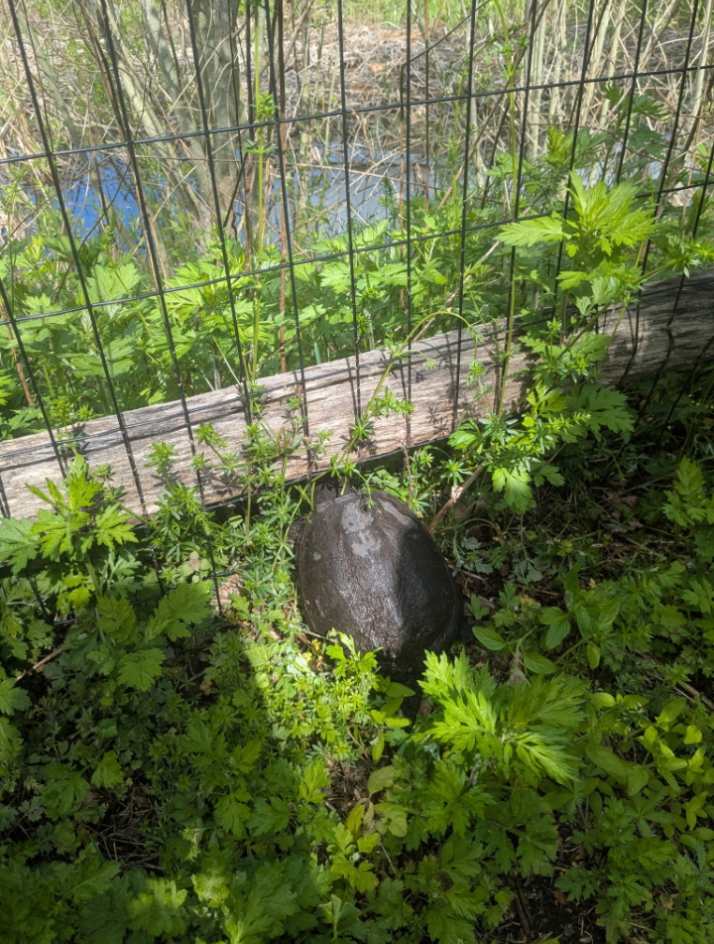
What began as a nature walk quickly turned into a lesson on habitat fragmentation for Eric Bergman’s D period freshman English class, when they discovered a snapping turtle trapped in a fence.
Bergman often takes his class on walks around the school. He finds that this is a great way to begin the class. The students write in their journals, and then head outside.
Two weeks ago, he took his class on a walk. “It was a beautiful day, and it’s that time of year we like to get outside. So we do these things called awe walks, where we look at the world and its wonders,” said Bergman.
Freshman Emilia Jacobson, a student in his class, had noticed something peculiar while walking. “We were going back to the school, and there were two paths we could take; either a cement path or a grass path. Me and my friend decided to go down the grass path, and we saw this big rock-looking thing,” said Jacobson.
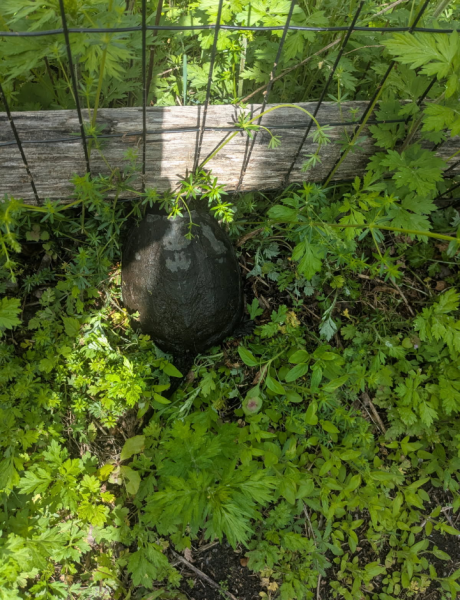
The path begins at the back of the school, and runs through wooded area to the bridge that leads to the sports fields. Fences border it, and block people from entering the wetland area.
At first, Jacobson could not make out what it was, but quickly realized it was a turtle. “It had its head stuck in the fence. We told the class about it, everybody came over, and we decided we needed to help it,” she said.
Animals are often prevented from expanding their whereabouts because of human involvement which can lead to habitat fragmentation. Habitat fragmentation is when parts of a species’ living area is progressively destroyed by human infrastructure, natural disasters, or agriculture. In a report for IFAW, it is noted that this process “leaves animals with less space and freedom of movement, but it also causes a number of short-term and long-term impacts on the health of individual species and their ecosystems.”
The turtle had gotten stuck because of a fence crafted by humans. Karen Martino, a biology teacher here at The Morgan School, provides her insight on the situation. Martino claims that “females do leave the water to lay their eggs around this time of year.” With the river nearby, the turtle was most likely looking for a nesting site.
The research agrees. “From May through June, the females seek the perfect sunny, sandy land for nesting,” writes Michayla Savitt in an article for New England Public Media. Since it is the mating and nesting season for snapping turtles, they are currently on the move to find somewhere to perform their usual activities. “This can be a risky trek for the snapping turtles’ rare journey from water: Connecticut’s roadways often cut through their path,” notes Savitt.
Roadways are the main issue; however, many other human structures impede on their migration as well. Fences are one example. Savitt mentions how this is especially problematic because “The death or injury of one of the adult turtles poses long-term issues for their population.”
In this same article, Mike Ravesi, a wildlife biologist at the Department of Energy and Environmental Protection (DEEP), highlights that ‘“They are long-lived, slow-to-reproduce animals…So it takes them sometimes a decade or more to reach sexual maturity. It can take a long time for those eggs that they produced to eventually result in additional adult turtles down the road.”’
Knowing they must save the turtle, the class quickly headed inside to find someone to help. “We went back into the building, and were looking for someone to help us cut it out. Eventually, we found the janitor, and he got wire cutters, and we headed back outside,” recalls Nora Lombardi, another witness to the trapped turtle.
Once refinding the turtle, the class immediately went into action. “The janitor cut it out, but the turtle was still stuck. The freshly cut wire just kept scratching its shell…It took forever, but after a while it made it through,” said Lombardi.
As this issue becomes more apparent, solutions are being sought out. One in particular is habitat connectivity. Habitat connectivity is the opposite of fragmentation. It is a “connected, wildlife-friendly landscape with large, protected land tracts, vegetated roadway overpass…and environmentally-responsible agricultural production,” writes The Nature Conservancy (TNC) in an article from earlier this year.
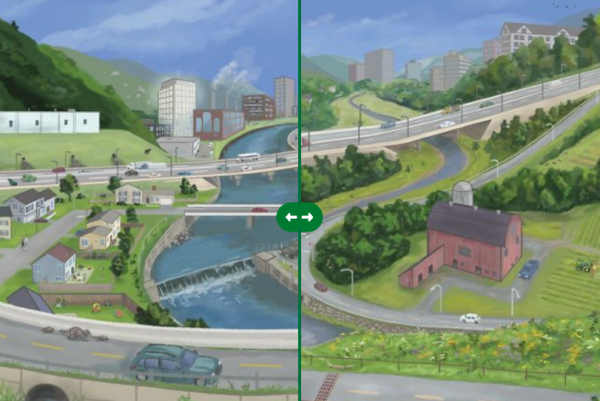
To implement this, “The Nature Conservancy developed a Habitat and Highways training program in partnership with transportation and fish and wildlife agencies from Connecticut, Maine, New Hampshire, New Jersey, New York, Massachusetts, Pennsylvania and Vermont.”
This program explores how transportation infrastructure impacts natural ecosystems, and provides ways to enhance terrestrial connectivity.
Jacobson finds that such initiatives would be very beneficial, as “We’re the ones changing them. We often view animals as an obstacle, but really we are the ones who hold so much power over them. We could choose to use it to help the animals, or to solely help ourselves.”
For Bergman and his freshman class, what was originally a simple walk became a firsthand look at a common ecological crisis that is often overlooked because it extends beyond people’s daily routines. However, performing acts like this are not to benefit one’s morale, but to maintain biodiversity for the sake of keeping a balance between animals and humans to ensure survival for both groups. As Lombardi puts it, “We need to make sure the school isn’t only safe for students and staff, but also the animals around it.”