


Before the social media era of trends and movements on TikTok, Instagram, and many more apps, all that was needed to have fun during the 1970s was a handful of dried beans, a scrap of leather, and two guys, John Stalberger and Mike Marshall, in an Oregon driveway, trying to rehabilitate a sore knee in 1972.
What started as a low-impact physical therapy experiment for Stalberger’s knee problems quickly defied social norms, which would go on to become an ultimate symbol of American culture. This would come to be known as Hacky Sacking. It would be a game of kicking this dried bean pouch back and forth in a group of people to keep it off the ground, using different body parts, such as your feet, knees, and chest.
Now, nearly 30 years later from when it was last trending, hacky sack is returning to Morgan in the form of a team – Morgan Sacskies. “We created it by just making an Instagram account, and then asking people to join in and send in videos,” Liam Totten, a senior at the Morgan School and one of the seniors who set up the Morgan Sacks team, said.
Totten found interest in this game because, as he said, “I feel like one day someone just picked up a hacky sack after seeing a video on social media and brought it to school, and it just spread from there.”
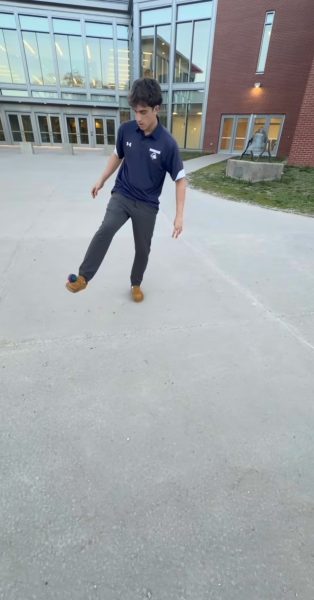
Andrew Randi, another senior at the Morgan School, and another one of the seniors who set up the Morgan Sacskies, gained interest in this little game outside the country. “For us, it started in Costa Rica,” Randi said. “A few kids bought hacky sacks, and we started playing with them on the trip. From there, we saw other schools and colleges creating hacky sack social media accounts, so we decided to follow suit.”
After many of the kids who went to Costa Rica and brought a bunch of hacky sacks back, the trend seemed to arrive at The Morgan School.
Arthur Dos Santos, a freshman at the Morgan School, said, “seeing it all over social media platforms, like TikTok, caused me to gain interest in this game, and seeing people doing cool tricks, like catching the pouch up on their backs and necks, also made me try out this little sport.”
“I think it’s a great opportunity to come together and have a good time,” Randi said. “We can share our hacky sack rallies online, and it creates a bonding experience to share with friends.”
Totten also agrees, adding, “I think it got so big so quickly because it is just an easy way for everyone to have fun and for everyone to come together and do something as a group.”
Explaining how simple it is to get featured in a video, since suggestions are public, Randi added, “It’s very random, really, anyone can just send a DM [direct message] to the Morgan hacky sack Instagram account with a video of them and their friend playing hacky sack, and if it’s a good and creative rally, it will get posted! As for me, it began with just a few of my friends.”
So far, the Morgan Sacskies’ Instagram has 298 people following them. They’ve posted 5 videos so far, where one of the videos is a collaboration with Morgan Track and Field. They’ve also been in a reel on the Morgan Pawprint Instagram, which was on the “coolest hacky sack skills”.

Due to this trend, prices of hacky sacks have nearly doubled, from $5-$6 to nearly $10-$12 for some vendors, and maybe even more for a bundle of hacky sacks. Even on Amazon, many hacky sacks were taking a long time to be shipped over to you by the start of May, due to the popularity of the game. If not taking long to arrive, many are being sold out on not just Amazon, but many other vendors, too.
Although Totten and Randi both play soccer for the Morgan boys soccer team, and Totten also plays MLS Next club soccer for Ginga FC, there are still differences between the two “juggling circles.” “I think that hacky sacking is much harder than juggling a soccer ball because of the size and material of the ball,” Totten said. “There are some different ways of how you need to touch the ball for it to go into the air, which is a learning curve when you first start to try hacky sacking.”
Randi also agrees to the higher level of difficulty, saying, “It is a smaller ‘ball’, but this does allow for some more interesting tricks that you otherwise wouldn’t be able to do with something like a soccer ball. Its small size also allows for some creativity, whether it be with your shirt, pocket, hat, etc.”
Stalberger’s invention has come very far, from starting as a low-impact physical therapy experiment for his knee problems to a social phenomenon. Before hacky sacking, Stalberger wasn’t even skilled in medical abilities, where he was a college football player and a recreational baseball player. He and Marshall, where they met during Stalberger’s trip to Oregon in 1972, made a small beanbag as a form of physical therapy for Stalberger’s knee, but saw something that could’ve been a fun game for everyone.
After realizing the potential of this little game, Stalgerger left his pursuits in recreational sports behind to work toward popularizing it nationally with his new business partner, Marshall.
Until the early 90s, hacky-sacking finally rose in popularity quickly. After toy giant Wham-O acquired rights of the hacky sack from Stalberger in 1983, the organization began to sell these hacky sacks with the same zest they were doing with hula hoops and Frisbees, where they were very popular as well at the time.
Since the interest in this game is rapidly increasing, there have been talks about starting an actual team for this “sport.” However, the two seniors think differently. “I think it’d be a tough ask, but I’m sure it’s worth a shot,” Randi claimed. “Maybe a club is more realistic.”
Totten thinks the same, saying, “For a sport, honestly, probably not, because there’s no way to compete in it, maybe a club for kids who want to have a good time after school.”