
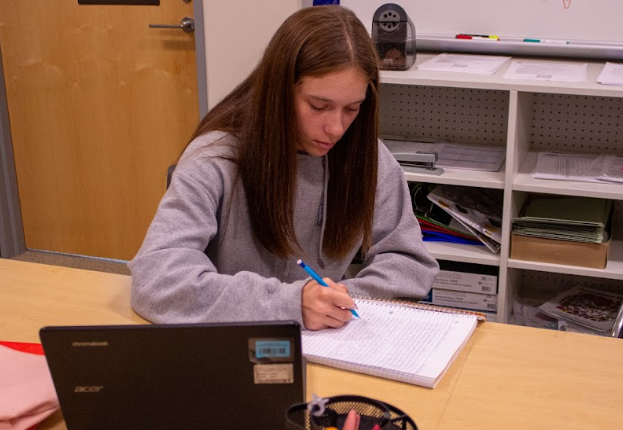
As Advanced Placement (AP) exams progress, students across the country have to be on top of their studying to be fully ready for the exam they have spent months preparing for. But when it comes to studying, methods may differ from student to student based on how they learn. Many people use AP Classroom or Khan Academy as resources, some more efficient than others, while others use methods such as “active recall.”
This school year, junior Alex Vece is taking five AP exams. AP Language and Composition, AP Biology, AP Government and Politics, AP Pre-Calculus, and AP Spanish. Taking this many AP classes can be stress-inducing for a student in the top 5% of their class such as Vece, but he found a study routine that works best for him. “I read over a lot of materials. I just read chapters of the Gov review book, and I watched videos” provided by “AP Classroom for Bio,” said Vece.
Junior Emma Holecz’s strategy for AP Gov was a combination of classroom prep and her own studying methods. “For Gov, we were doing practice quizzes during class every day,” said Holecz, “at my own time, I would be doing Princeton Review and highlighting and annotating for the ideas and vocab terms.”
The Princeton Review is a tool that students utilize, which provides studying and tutoring resources for AP courses. For the most part, it is free. Despite having a cost, it contains significant free resources for students to access.
While initially struggling with certain units, junior Mekai Howard had to figure out how he would study this material. “For Gov, I did focus a little bit more on specific units that I knew I didn’t know as much about,” said Howard, “I focused on making sure I had all the foundational documents and court cases memorized.”
In AP Gov, the Supreme Court cases are important cases to have in one’s head. These cases are the fundamentals of the U.S. Constitution. We know what the Constitution is, but the court cases help provide reason as to why it is the way it is.
Along with Princeton Review and other websites, Heimler’s History is also a popular tool among AP students. Created by Steve Heimler, a former history teacher from Georgia, Heimler’s History provides review guides in order to prepare students for not only the AP exam, but also to maintain high grades within the class.
Heimler’s History is a fan favorite due to the fact that it provides study tools that contain direct material from AP courses. Heimler’s History also has a Youtube Channel, with over 1.15 million subscribers. Therefore, it is seen that it is a popular resource.
“I bought a review guide from Heimler’s History, and that kind of goes along with like that same philosophy of acts of recall and writing it down,” said Howard, “I used the note guides while watching his videos to write it in my own words, which I think helped me understand and remember.”
These study methods are very typical for the average AP student. It can consist of rewatching videos, reviewing notes, etc. While common, many people find it effective.
Howard has somewhat of a unique approach to studying as well, finding his own personal method that works best for him. “My overall general studying method is active recall,” said Howard.
Active Recall is a method used where one tries to think of everything in the subject that they can. Once this is done, they’re meant to review what they missed and repeat until they master the material. To get the best effect from this method, “it is better not to verbalize it, but write it down,” said Howard.
The reason active recall is so effective, is because it forces the brain to retrieve information, and testing yourself rather than reviewing, which creates better results for long-term memory.
It also greatly highlights what someone does not know. It ensures that time is focused on material one isn’t familiar with, rather than wasting time on material that has already been mastered.
When Holecz studies, she finds it difficult to memorize the material and move on with her day. For the most effective study session, she has to utilize a verbal method; talking aloud to herself or to other people.
Holecz has a similar method of studying as well, but adds a verbal component to her preparation, differing from Vece’s way of preparation. “I think the most effective for me is writing everything down, and then reciting it to myself, or talking to someone else about it, especially for Gov,” Holecz said.
In order to score a 4 or a 5, it is crucial to make time to study. The common percentage rate among AP exams to earn a 5 is roughly from 70%-75% accuracy. Even though this is a particularly low accuracy rate, the idea of scoring a 5 tends to build up pressure onto students.
For the SAT, according to Khan Academy, it is recommended to start studying the summer before Junior year for desired results.
While AP exams and the SAT are two different exams, they follow the same concept of starting to study early on.
For AP exams, it is important that the material has been fully covered before studying starts. The Princeton Review recommends that students start to review their material in February or March, typically 2-3 months away from when AP exams are held.