
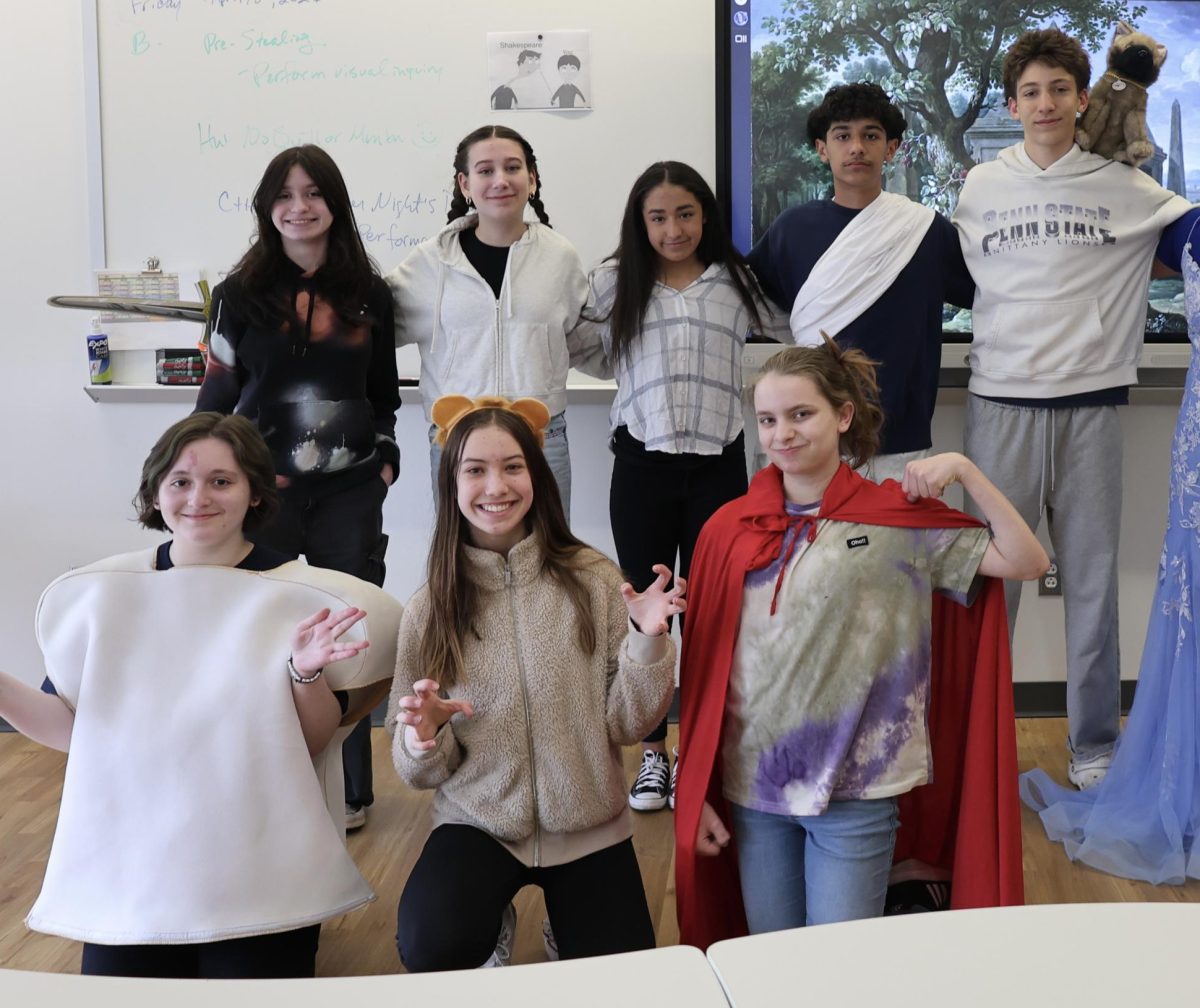
“This lion is a very fox for his valor,” freshman Kamryn Dwyer proclaimed. Had it been any other school day, her classmates would have responded to the line with confusion. But on that day she was not a Morgan student. Her name was Lysander, for this was the freshmen’s production of A Midsummer Night’s Dream.
During Ms. Frydenborg’s C and H period English classes, on Friday, April 10th, freshmen such as Dwyer could be found mid-performance, dressed in costumes that ranged from a royal king to a wall. They were putting on the Mechanicals’ version of Pyramus and Thisbe, a comical performance that they had to execute with emotion and effort. The steps they took to get there were not small—the play took over a week of preparation and dedication.

“We had to organize ourselves and really pay attention to details,” recalled Mikyla Sobczak, who played the role of the lion in her C period class’ performance. She and her classmates had to rearrange the room to create a makeshift performance area at the front of Ms. Frydenborg’s room. They moved chairs, set up audio cues, and even found a backdrop to display on the smartboard, attempting to fully capture the Shakespearean essence of A Midsummer Night’s Dream. “We had to make sure that everything was organized because it was being recorded.”
The planning stage was messy: once the roles were distributed, the freshmen set to work annotating their scripts, roughly memorizing their lines, and brainstorming their costumes. As the week progressed, they began to put more emotion into their words to better perform the scene. “Ms. Frydenborg definitely helped us with emotions and acting,” said Sobczak, who feels that her teacher and peers helped bring the performance to life. As the lion, she did not simply have to roar—she had to respond to her peers’ reaction to her ferocity. She noted that this type of acting not only made more sense to the audience, but helped the scene move more smoothly for the actors themselves.
Because the freshmen had a lot to consider, there was uncertainty that the final production would be messy. However, all the time they spent rehearsing paid off. “The problems were minor,” Sobczak said. She was thankful for the time they spent planning, as it gave them enough time to work through any issues. “We talked to each other and figured it out through teamwork.”
For C period, the freshmen’s peers and Ms. Frydenborg were not the only people there for them to rely on. Since this was the fourth year Ms. Frydenborg was doing the performance assignment, she called upon a group of sophomores and juniors who performed in prior years to assist in the production. These students not only gave the freshmen advice on how to put on the play, but actually acted in the performance itself. “They helped us stay organized,” said Sobczak. “They helped the play make more sense, to us and to the audience.”
“The whole unit is not just understanding the play,” said Ms. Frydenborg, “it’s bringing the play to life.” Her students had to take into consideration the in-between moments where they were not actually speaking, and had to figure out when to enter, how to react, and how to interact with each other. “There’s so much to think about.”
The freshmen’s performances were being assessed as a project grade, but they were also given the option to use the play as a Junior Portfolio assignment, a sign that the effects of the production will reach far beyond their ninth grade year. “This is great to show off collaboration skills,” explained Ms. Frydenborg. In order for the play to come off well, students had to work with one another to direct, plan, and perform. “It’s the ultimate one in teamwork.”
For this reason—as well as the comprehension and text-to-life skills the play gave its performers—students and teachers alike feel that this is beneficial enough to venture outside of Ms. Frydenborg’s classroom. “This should be done in other classes,” Sobczak said. “It’s a great way to improve communication among peers, and organization skills as well.”
“I think it would work great in a history class,” added Ms. Frydenborg. “It’s a great way to show your learning.” Both Dwyer and Sobczak found that their understanding of Shakespeare improved when they took the play a step further from simply reading and analyzing.
At the end of the class period, once the performance was over and the freshmen had said their final lines, students were able to look back on their play with excitement. “I know it’s just an assignment,” Sobczak reflected, “but this was something fun. It brought us together as a team.”