
“Despite the rapid rise of messaging applications and social media platforms, texting remains the most prevalent form of communication with peers,” reports
the National Library of Medicine. Over time, texting has integrated itself into people’s everyday lives. It allows individuals to make connections with those closest to them, but also enables many to communicate across long distances from the comfort of their own home. Despite how effective it may be, digital communication comes at the cost of social skills. However, one teacher wants to change that.
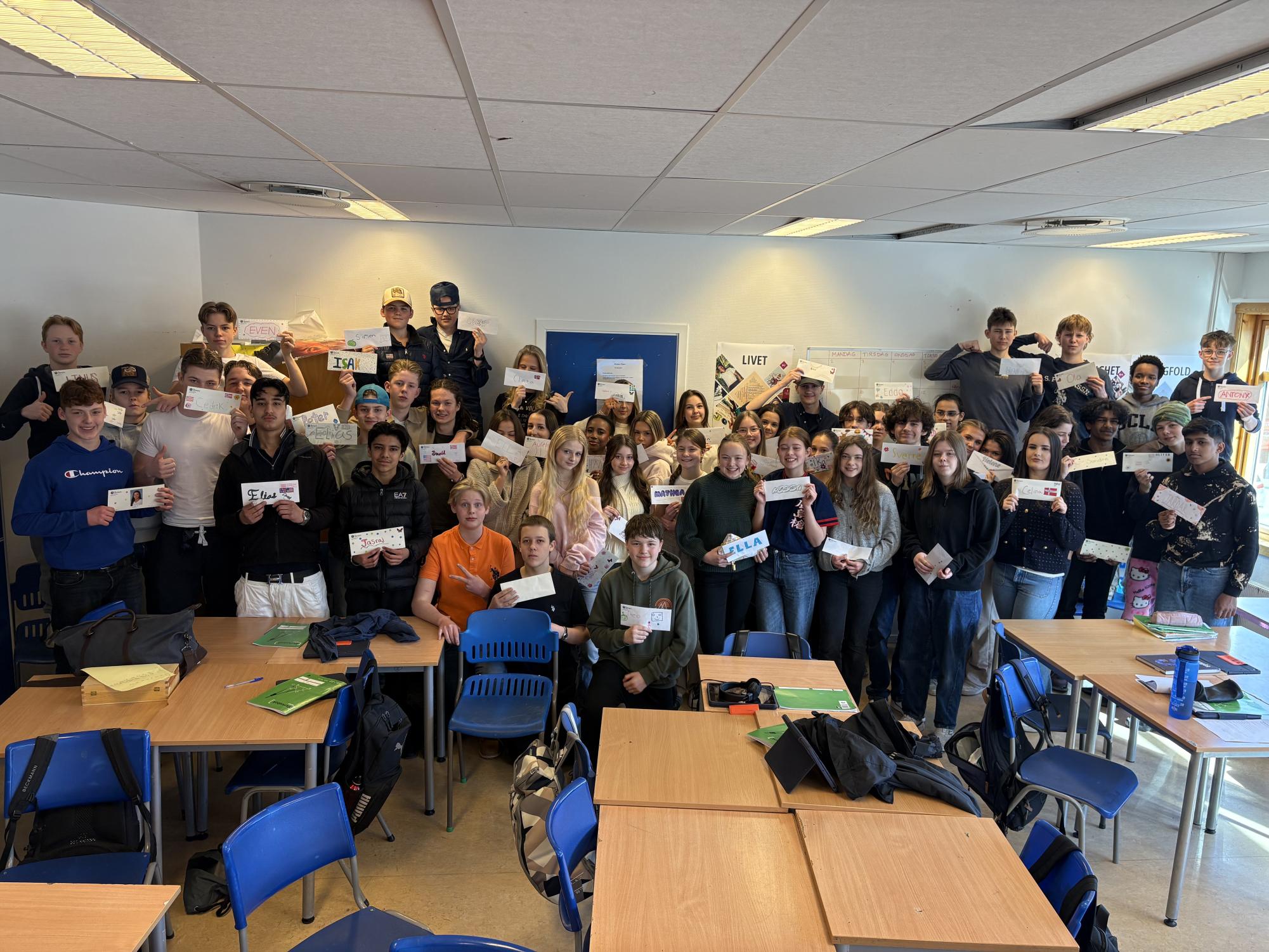
Eric Bergman, an English teacher here at The Morgan School, has started a program where students in his classes participate in a letter exchange with high school students from Oslo, Norway. Through this experience, students are able to learn that they do not have to rely on their phones to make deep connections.
Earlier this school year, Bergman reconnected with one of his former students, Kelli Carlson. Now with her own students in Norway, Carlson was seeking to help them interact with their peers internationally. She had posted on social media addressing this and Bergman saw her post, quickly responding with the proposal of a pen pal program.
“When I saw that, I said, what a wonderful idea,” said Bergman. He thought it would be a great opportunity for his students to meet new people, but also learn about other cultures. When Bergman got in touch with Carlson, their plan was set.
Bergman and Carlson spoke, and he mentioned how he had sixty freshmen to participate in the program. Carlson had one hundred students, so Bergman decided to include his junior film study classes as well.
In an article for NBC, Maggie Mulqueen writes “Our increasing preference for texting over email and phone calls creates a higher quantity of interactions, but it decreases their quality, harming our relationships. Indeed, it’s a far cry from paying attention and listening to the thoughts and feelings of another person, and it’s missing the human contact and learning that comes from true dialogue.”
When texting, there is a lack of materiality that can lead to misinterpretation. For Bergman, physical presence and handwritten notes offer a level of intimacy that technology does not. Although it comes with many benefits, technology can prevent meaningful, in-person connections from being formed.
Due to receive their letters any day, the students participating in the program are very excited to learn about their new friends. Emilia Jacobson, a Morgan freshman in Bergman’s D period English class, is enticed by this project.
“We haven’t been able to do any of these activities in the past, and it’s a very remarkable experience. It teaches you a lot about others, and also makes you more mindful of the world around you,” said Jacobson.
Jacobson finds that something tangible, such as a letter, holds much more value than a text message which can often seem lifeless. “It’s important to communicate through letters because having a physical piece of paper and reading handwritten words feels like a genuine connection compared to texting,” said Jacobson.
The letter, though fun to write, did challenge Jacobson as it made her put in more effort than when crafting a text message. “Organizing my thoughts so the letter flowed smoothly was difficult. There were several criteria we had to include in our first letter, and it was hard at times to make the wording sound natural,” Jacobson said.
In the letter, the students needed to include their thoughts regarding the program, a paragraph about Clinton and Morgan, their hobbies and interests, and some questions to learn more about their pen pal. Jacobson first struggled to write the letter in an organized way; however, once she found a strong starting point, the process became much easier. “It was very important that the letter appears neat and structured since this was the first and only impression they would have of you,” said Jacobson.
Through this experience, Jacobson was looking to go beyond surface level and start her connection off with more depth. “A major part of this whole letter exchange is getting to know a person you would have never met otherwise. Essentially, being able to really understand a person without having any prior information about them,” Jacobson said.
Katelyn Ramirez, another freshman participant in the program, shares similar opinions with Jacobson. “Knowing how to use different types of communication is especially crucial now since our generation is addicted to phones…interacting with people is different when they aren’t hiding behind a screen,” said Ramirez.
The research agrees. In an article for Greater Good Magazine, Jill Suttie writes about researcher Kostadin Kushlev and his colleagues at the University of Berkeley conducting a study where students came into a small lab room either with or without their phones. During the experiment, they were videotaped to see how often they smiled, if the smiles were genuine, and how much of the wait they spent smiling. After studying the video thoroughly, Kushlev discovered that “People with phones exhibited fewer smiles overall (and fewer genuine smiles), and spent 30 percent less of the time smiling than people who didn’t have their phones with them, signaling less interest in connecting with others,” wrote Suttie.
The people who did not have phones were looking to mingle with their peers, while those who brought devices were kept occupied, uninterested in making conversation. Suttie included that “Kushlev and his colleagues also noted that thirty-two participants with phones didn’t interact at all in the waiting room—while only six people without phones didn’t interact.”
There is a major imbalance of socialization between those who had their phones versus those who did not. The use of technology in a public setting is causing people to be less aware of their surroundings, leading to disinterest in meeting new people.
Ramirez finds that texts require little thought and concentration, while a letter takes time and much pondering to craft. “With letter writing, there’s a thoughtful piece to it. The action of actually writing creates a more intimate experience.”
The program is helping Jacobson have a broader outlook on the world around her. By communicating through letters rather than text, she has been able to express herself, developing her personality through the writing process.
From this lesson, she has gathered that “it’s really important that you learn about people other than yourself, because we’re always so caught up in what we have going on, and we don’t really acknowledge what is actually happening around us.”