

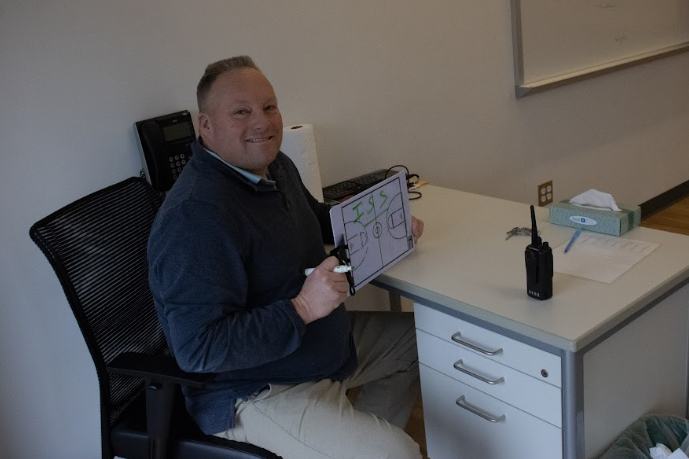
ISS is one of many ways to deal with misbehaved students at Morgan, acting as a discipline system that allows them to remain in an academic environment while still facing punishment. During this time, it is expected that students continue to do their schoolwork, but deeply reflect on the actions that landed them there as well. Although it is a restorative process, some students seem to think otherwise.
Recently, freshman Emilia Jacobson spent a day in ISS. She’s had conflicts in the past, but none had landed her in a situation like this. From both her experience and the input of her peers, she came to the conclusion that in school suspension is not beneficial to the students who must attend. “You know, most people when I was there told me that they just kept coming back…it doesn’t really teach you anything,” said Jacobson. She developed a negative perspective towards ISS because even when Jacobson explained her situation, the authority figures deciding her punishment did not address her side of the story. “The people deciding my punishment heard what I had to say, but they didn’t actually listen, and weren’t able to see my perspective to inform their decision,” said Jacobson.
Rather than viewing it as a learning experience, Jacobson claimed that ISS only leads students to become more defiant. Everybody’s reason for being there is different, and the system does not seem to address individual issues, causing the root of the problem to feel unaddressed in the perspective of some students. “Hagness and Luther told me that everyone has to be treated the same, no matter what their situation is…depending on what you did, you could be in ISS a similar amount of time as someone who beat up somebody, or you could just have told the teacher that you didn’t want to do anything,” said Jacobson.
Students receive punishments if their actions violate the schools code of conduct, yet sometimes the reason seems inconsiderable compared to others. Jacobson believes that “Though it may be difficult, a deeper investigation is needed to truly prove whether students are actually guilty.”
In 2021, the American Institutes for Research (AIR) found that “exclusionary discipline is not only ineffective at producing positive behavioral change but also linked with a host of short- and long-term negative outcomes in schools, in the community, and intergenerationally.” Disciplinary measures such as ISS have been affecting people for decades. Through studies it has been proved that they do more harm than good, though the negative effects have been ignored because it is difficult to change practices implemented years ago.
Changing the system is challenging, but it’s possible. “Between 2012 and 2016 alone, 27 states revised or released guidance to change disciplinary practices that rely on exclusionary consequences, and more than 50 of America’s largest districts reformed their discipline policies to include nonpunitive strategies, limit the use of suspensions, or both,” reports AIR.
Influenced by research along with many other factors, various schools across the United States were able to change their policies to better accommodate students. A school district in Watertown, Connecticut is participating in the School-Based Diversion Initiative (SBDI). The program is to reduce exclusionary disciplinary practices as much as deemed essential. This lowers the suspension and expulsion rates while ensuring students receive appropriate treatment regardless of their individual circumstances.
Dr. Alison Villanueva, Watertown public schools’ superintendent, believes that the more restorative approach will lead to a more positive environment for staff and students. However, she also thinks that all measures requiring exclusion do not need to be abolished.
In an article for FOX16, Villanueva said ‘“It doesn’t mean that we don’t still have exclusionary discipline. Sometimes some behaviors, according to our policy, rise to the level where a student does belong out of school…But what’s also true is when a student is out of school, we don’t know what they’re doing and it’s better when they’re in our care, receiving counseling, receiving behavioral mental health services and being with a trusted adult to talk about things.”’ With a restorative intent, many components such as mental health are now being addressed, leading to a more proactive approach.
Chris Luther, the Assistant Principal here at Morgan, believes that while some parts of the system are good, others need improvement. When deciding if a student will go to ISS, it takes time to reach a verdict. The resolution is based on both what the students themselves did, but also how it affected their peers. Administrators don’t only base their decision off one’s accountability, but must weigh how to maintain a safe environment for the rest of the student body as well. “We can agree to disagree, and I can make a decision based on all the other students here, and if they don’t agree, that’s okay…sometimes I’ve had students come back to me and say, you were right, I shouldn’t have done that. I get it now,” said Luther. He finds that often a decision may not make sense to the affected student at the moment, but there is the possibility that they will later realize why such a choice was made.
Luther also believes there are opportunities for further development. He would like ISS to be more than just sitting in a room, and instead a true opportunity for a person to learn from their mistakes in order to not make them again. “Something that I would do to make it better is give more opportunities for the students to reflect…maybe write something saying this is what I learned, and this is how I’m going to change,” said Luther. He thinks a more upfront approach would impact the students in a more profound manner, allowing them to genuinely benefit from the experience.
Principal Kerri Hagness shares similar ideas with Luther. She states that “When we make a determination for how we use ISS, there is a policy to follow, right? But we are also looking beyond consequence to a more restorative approach.” Both Hagness and Luther’s intentions go beyond school policy, looking to help the students progress into a better version of themselves. They are aiming to make ISS something that has a lasting impact, hoping that the students will move forward without conflict.
In contrast to the negativity surrounding ISS, the teacher who supervises the students at Morgan, Trevor Brown, thinks that the system does not need to be improved. “It gives the kids a chance to get out of class, allowing them to concentrate on themselves, get their work done, and process the potential they want,” said Brown. By keeping the students in an academic environment, they can continue to work efficiently while remaining undistracted. As the overseer, Brown is able to get to know the students a bit. By doing so he can get a feel for their situation, allowing him to gain a better understanding of what may be going on. From his time supervising, Brown concluded that “It’s a very good system as it is right now. I don’t think there has to be anything changed.”
Regardless of the conflicting views regarding in-school suspension, students may feel that the broadness of the system does not allow them to explain and work through their difficulties directly. Hagness highlights how errors are essential for growth, and without them people would be unable to adapt to their situation, “One decision never defines you…it’s an impulse of decision that helps you learn going forward.”