
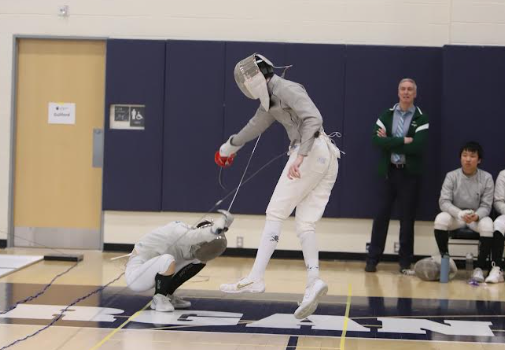
From the winter of freshman year to now, Joseph Morrissey, a junior at The Morgan School and sabre fencer on the Morgan fencing team, has dedicated his life to his fencing career. Winter or Fall, Morrissey is out there fencing. All of this hard work has led him to qualify for the Junior Olympics, where he faced some of the greatest fencers in the country.
The Junior Olympics took place in Kansas City from January 9th to the 11th. Morrissey described the experience, saying that “being able to go to new places, meet all these people, meet all these coaches that were world champions in the Olympics…just overall…was a great experience.”
Morrissey arrived in Kansas City on January 8th, a day before the first tournament started. January 10th was a free day. On January 9th and 11th, Morrissey woke up two hours before each tournament to have breakfast and prepare for the long days ahead. There were two tournaments, one on the 9th and the other on the 11th, that Morrissey fenced in. Walking into the building was a brand new experience for him.
“I felt like I didn’t belong because I never did something this big,” said Morrissey.
Once he settled in, he started with private lessons from his coach to warm up and fix any mistakes. After that, he started to do his stretching exercises.
“About 20 minutes before start time, I would fence random people,” said Morrissey, “to get a feel for people’s styles.”
Pools start all fencing tournaments. Pools are when all fencers are divided into groups of usually 5-7 fencers, who all fence each other. A strip is the area fencers have to fence on, 14 meters long and 1-2 meters wide. Morrissey got to his strip and waited for his name to be called.
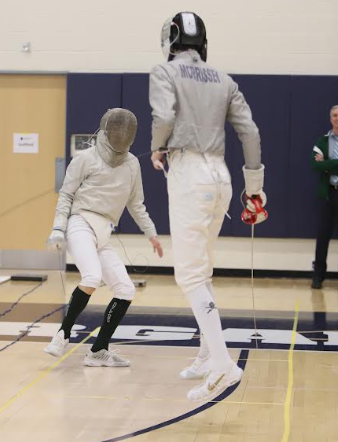
“I did very well in pools,” Morrissey said. “I had to fence an A-rated,” the highest rating in fencing, “and two B-rated”, the second highest rating in fencing, “and I beat them, and I hit my favorite flashy move called a jump parry two,” a difficult and powerful move.
After pools, a seeding chart comes out with the rankings of each fencer. To proceed to the next round, which starts the direct elimination matches, called bouts, a fencer must place in the top 75-80 percent. Morrissey was able to advance to the direct elimination round.
The direct elimination round is like a basketball bracket, but for each fencer. To advance to the next round, the fencer must win and score 15 points, which are called touches. Unfortunately for Morrissey, he lost in his first direct elimination bout for both of the tournaments he fenced those two days. “I still put up a fight and made it close,” said Morrissey.
For both tournaments, Morrissey ended up placing 180th.
Once he was done fencing, Morrissey spent his time exploring the area. “I would walk around and explore to see what other places are like compared to Clinton,” Morrissey said.
By the end of the day, he would go to restaurants with his parents, and end his night watching TV in the hotel room.
“I can think of two moments that I probably won’t forget…” said his mother, Mrs Morrissey. “My second happened at Junior Olympics this year. In pools, it was a 4-4 bout, and Joey did a Jump Parry Two, nailed it, and won the bout. Mrs. Morrissey said he came off the strip and said, “Did you get that on video? Please send it to Coach Alex.”
According to Mrs. Morrissey, this was a moment to remember. Morrissey’s hard work and dedication led to his substantial success in fencing and his own mental battles.
Morrissey grew up with three older sisters, all Morgan graduates and fencers.
Olivia Morrissey, who fenced sabre. In sabre, touches can be scored on the entire upper body. Sabre has certain rules that dictate which fencer gets the touch if a double touch is scored. Sabre is also the fastest of the three weapons, so it has no timer, unlike epee and foil.
Lillian Morrissey, who fenced epee. In epee, touches can be scored anywhere on the body, and there are no rules to dictate who gets the point. This means that double touches can be scored. Both epee and foil have 3-minute timers.
Finally, Sara Morrissey, who fenced foil. Similar to sabre, foil has rules that dictate who gains the touch if a double touch is scored. On the other hand, foil has the smallest target zone, only covering from the pelvis to the neck, excluding arms.
“In seventh and sixth grade, my parents were telling me that I should do it, but I didn’t really find it too interesting,” said Morrissey. “But eighth grade came around, and I started watching it more, and I became more interested in it.”
Over the years, his interest in the sport grew. He became more exposed to it through his parents and watching his sisters during his eighth-grade year. He was able to meet other people on the fencing team and watch matches more as his interest grew. This led him to want to join the team coming into Morgan. When he joined the team, he fenced under Coach Alex Rauccio, who still coaches the sabre squad today.
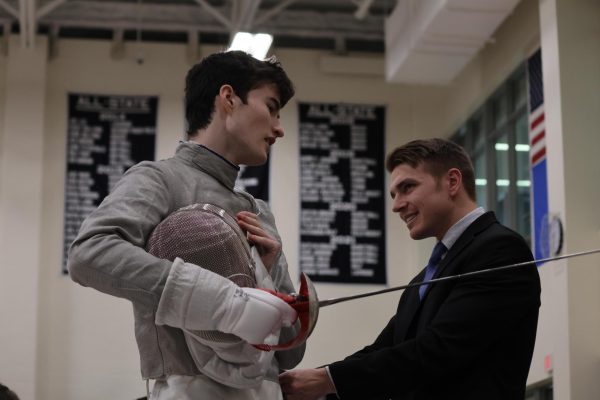
“Alex has helped me a lot with…skills and pushing past what I thought, but mostly he’s helped with the mental aspect,” said Morrissey. “I had some’ mental ‘struggles last year, freshman year…and I would talk to him about it, and he would help me.”
Morgan fencing’s coaches try to work as mentors for their athletes, as Morrissey has experienced. Head coach and Foil coach Jim Barnett, Epee coach Andrew Daly, and Sabre coach Rauccio are there to help their athletes outside of the sport. Morrissey is one of many on the team who have reached out to them for help and has grown tremendously from it.
“I’ve seen his confidence grow both on the strip and with the squads, and with his knowledge of the sport,” said Rauccio. “The more he’s learned, the more confident he’s gotten. And I think that’s increased his overall skill and ability both on the strip and in leadership.”
Along with Coach Rauccio, Mrs. Morrissey has also seen extraordinary development within him from fencing.
“I think fencing has made Joey more confident, more resilient. It has shown him you’re not always going to win,” said Mrs. Morrissey. “I think overall he is a better person, friend, student, and athlete because of fencing.”
Coach Rauccio has observed this as well within Morrissey, as he said, “he’s always rooting for the younger guys and the older guys’ and wants to see everyone succeed. ‘…whenever the girls are fencing,” Rauccio said. “He’s always right there next to the strip with them.’ On the side of the strip, he gives tips and tricks, and what he notices that they can change or keep doing to help them win.”
During the off-season into his senior year, Morrissey plans to continue training and working hard to finish strong in his final year on the Morgan fencing team.
“He’s hardworking…” said Coach Rauccio. “He wants to succeed, and he wants to see his teammates succeed.”