
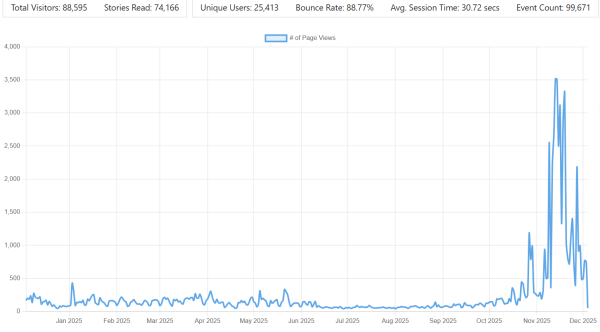
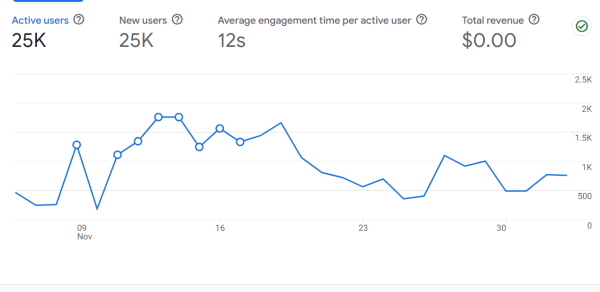
 Last month, Eric Carroll, an English teacher and journalism advisor at The Morgan School, checked the views on every Pawprint article to see how many people viewed the articles, but what he saw truly shocked him. The Morgan Pawprint has skyrocketed in popularity during November – the views, which generally hovered around 75 people a day, suddenly showed a several-thousand-person increase. At first Carroll was excited, but quickly he realized that the numbers were too farfetched.
“It was just kind of self gratified moment of like, oh, my gosh; I was just excited to show the kids. And I wasn’t really thinking about the massive numbers and how ridiculous it was,” said Carroll.
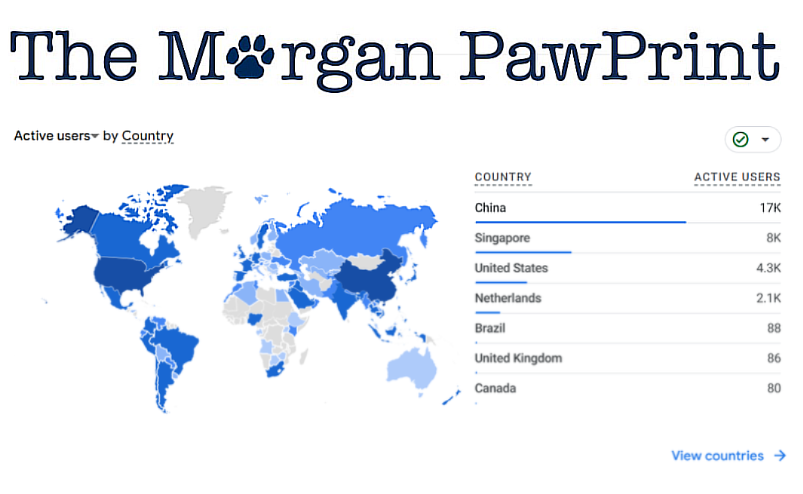
In November alone, Pawprint had over 43,000 viewers, 27,000 stories read, and 25,000 unique users on the site. These numbers far exceed the population of The Morgan School at 440, and even the population of our town, Clinton, a town of 13,000 people, and what makes all of this deeper is the fact that the viewership comes from China and Singapore.
At first, Carroll thought that The Morgan Pawprint skyrocketed in views and was excited to show all the kids in the class. The gratification of the charts and large numbers almost removed the thought of why the numbers are so large.
“Then I remember the email I saw in my inbox from SNO [the company that oversees the website],” said Carroll, “and for some reason, I went to check it, and it was a whole email explaining that the updraft [new viewership] was all about bots, and I was a little bit devastated.”
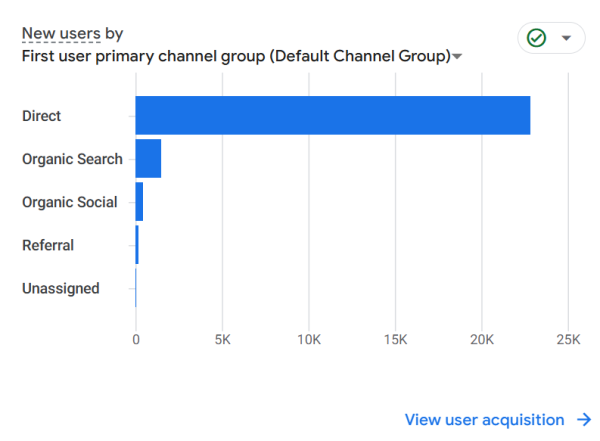
What really happened was that servers in these countries were sweeping the internet for data to catalogue, to make the servers more secure. When a website tracks analytics, it tracks more than just views; it also tracks how users found the webpage. It tracks this by separating
how the website was found into 4 sections. One of these sections is called direct, and this is where the issue lies. Direct views are counted by the number of people who typed in the exact link to the webpage into their search bar. According to Google Analytics, the number of people who did this was over 20,000.
The other three sections are organic search, organic social, and referral. When looking at the three remaining sections, they don’t even reach a fourth of the amount of direct searches. The second highest category is Organic Searches, which occur when a user searches for the name of the website and clicks a link while still on a Google page. According to Google Analytics, the most common way for new users to come across a website is by organic search.
“The recent, sudden spikes in traffic are likely due to a new, targeted form of inauthentic, non-human traffic (bots) that is currently bypassing the standard filtering systems,” said Raúl Revuelta, a SEO on the Google help pages.
Multiple sites are having this strange occurrence. Google typically filters out these bots, but the large uprising of these malicious bots has forced the site filter to stop working. According to Cloudflare, one of the largest server networks in the world, they are experiencing the same issue, so it is not just Google Analytics and Google pages.
The direct cause of the sudden uprising of the bots is unknown, but the assumed reason could be VPNs. China and Singapore both have extensive internet infrastructure. Virtual Private Networks, or VPNS, are actively hosted in these two countries because of their vast infrastructure. If a person views the site while connected to a VPN that uses a Singaporean or Chinese server, it will show up in any analytics page that a user is viewing the site in the country of origin for the server.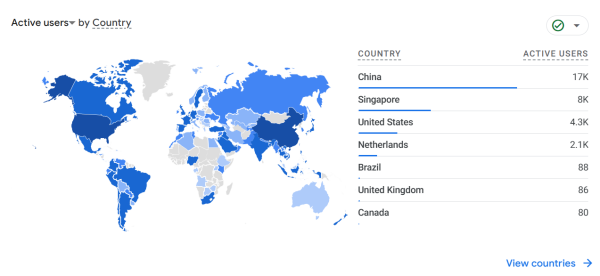
While VPNs may be a cause for the small amounts of out of country numbers on the analytics page, it in no way could lead to tens of thousands of users on The Morgan Pawprint. This points to Global crawls to be the most likely reason for the large amounts of active users. Global crawls are automated processes of bots travelling through various webpages in their database to scan and index different portions of the internet.
Since China and Singapore have such vast infrastructure, they need to focus on cataloguing parts of the internet to keep everything neat and organized. The entire internet contains 175 zettabytes of data, which in CD form can wrap around the entire world two hundred twenty-two times. This amount of data can get very clustered quickly, and these crawls help catalogue all of this information.
The internet is huge and contains generations of knowledge within it. Since there is so many files on the internet, someone has to catalogue them to make things easier to find, and that is exactly what China and Singapore did. All of the views that our school’s articles received were all part of this cataloguing process.
“I think when you have someone else reading articles beyond me, it makes it worth your time versus just doing it for a teacher,” said Eric Carroll.