

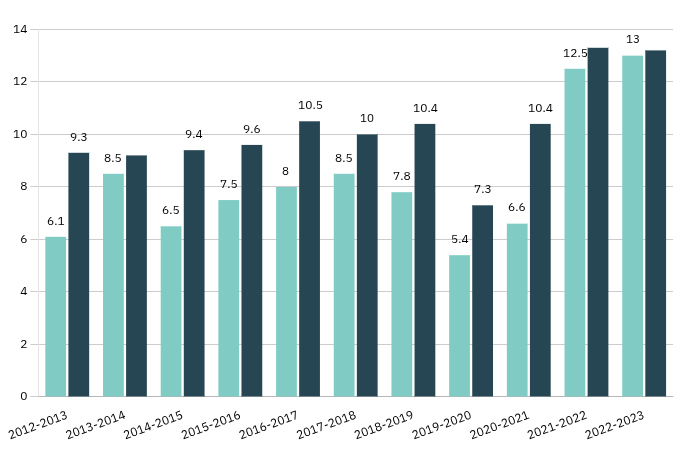
According to EDSight, the Connecticut State Department of Education, Morgan teachers’ absenteeism rate has skyrocketed over the last decade affecting consistency in the classroom for teachers and students. “I feel almost let down and lost when I walk into class, with questions to ask about the previous night’s homework and see that there is a sub,” senior Abby Stack reflected.
From 2014 to 2023 there was a dramatic increase in teacher absenteeism across the country, affecting Clinton public schools. A Brookings article suggests that “a strong majority of schools saw increases in teacher absenteeism.” This alarming data has raised concerns about how administrators and students will be able to adjust to this new rising issue.
It is not just a national issue. From 2012 to 2020 the number of teacher absentees in the Clinton school district doubled from an average of 6.6 days to 12.5 days.
Morgan Principal Keri Hagness recognized this outstanding pattern and believes COVID is to blame, saying, “We’ve seen kind of a trend of increased absences as we got closer to COVID and then during COVID and then post COVID.”
For Hagness, many factors may have contributed to the spike. One area of argument that she provided was that protocols during Covid were very strict, causing many required days home after exposure or after the illness was spread in the classroom. The CDC recommended schools to have students and teachers exposed to quarantine for several days and follow strict mask use when returning. Hagness added, “the numbers of staff members who had to take care of their family members, that was another component.” The COVID restrictions gave teachers more time off when having to deal with family matters during the pandemic.
Stack, who was in seventh grade at the time, remembered being sent home from Eliot middle school after being exposed to covid. “I was in the middle of English class and got called down to the office and told to bring all of my stuff.” She added, “I had been exposed to COVID and had to stay out of school for the next week.” Going from in person learning, to joining a zoom call from at home, it was harder to understand the lessons and communicate with teachers while they were trying to balance both online and in person classes.
According to EDSight data, absenteeism slowly started rising leading up to the COVID-19 pandemic, spiking during it and now staying at these high numbers. In 2019-2020, just before COVIDs strike, teachers in Clinton’s district averaged 5.4 days missed compared to the statewide average at 7.3 days. However, once teachers and students returned to the classroom, that number skyrocketed to 13 days.

This rise in absenteeism brings new challenges to the classroom for students and faculty. With more absenteeism comes less learning, said Morgan math teacher Elizabeth Criscuolo. She shared, “I think that students take the class work more seriously when their teacher is there, and I think that students think when a teacher is absent that it’s just busy work and that it’s not going to count, or it’s not important.”
To adjust to this new dilemma, Hagness and the administration push to “try to get the most qualified person in there so that the information and the learning continues.” To get in front of this, the search starts once they know a teacher is going to be out. Hagness said, “we try our best to provide some consistency in the classes, which is key.”
The goal is to ensure high-quality substitutes are taking their place. “We do try really, really hard to replace them with the best possible situation, ideally, a certified teacher.” Hagness shared, “they know the routine, and they know the students,” emphasizing the importance of the knowledge of the classroom regulars and routines that the students are used to.
It’s not always possible to find a certified teacher to cover classes, which does not contribute to the rise in teacher absenteeism. Morgan often is able to find coverage in classes using familiar substitutes like Mr. Astry and Mr. Walling. In case coverage can’t be found, other Morgan teachers often help cover classes when in need, but aren’t there to cover long term absentees.
While the teachers and substitute schedules change with absentees, the students schedules do too. Stack said, “I feel like we put class on pause when the teacher isn’t there.” A Rockford Register Star article suggests that students correlate a substitute teacher with an “easy” class, suggesting that having a substitute leads to lower student achievement.
After years of these high numbers, Hagness believes they may finally be reaching normal rates again, saying “right now we’re in a trend where we’re stabilizing, and those numbers are definitely much better than they were.”
This is not just a Clinton issue. While Morgan’s numbers significantly increased surrounding the virus, so did surrounding schools. From 2019 to 2023, Clinton school district’s teacher absences averaged 9.4 days, while Old Saybrooks school district averaged 13.5 days. In 2019 to 2023, Connecticut schools averaged 11 days missed by a teacher, leaving Clinton public schools below the average amount of missed days.
The continuous problem of teacher absenteeism has reached an all-time high in many school departments in Connecticut and is not going unrecognized. Hagness remarks, “we try our very best to manage those particular issues that come up.”
