
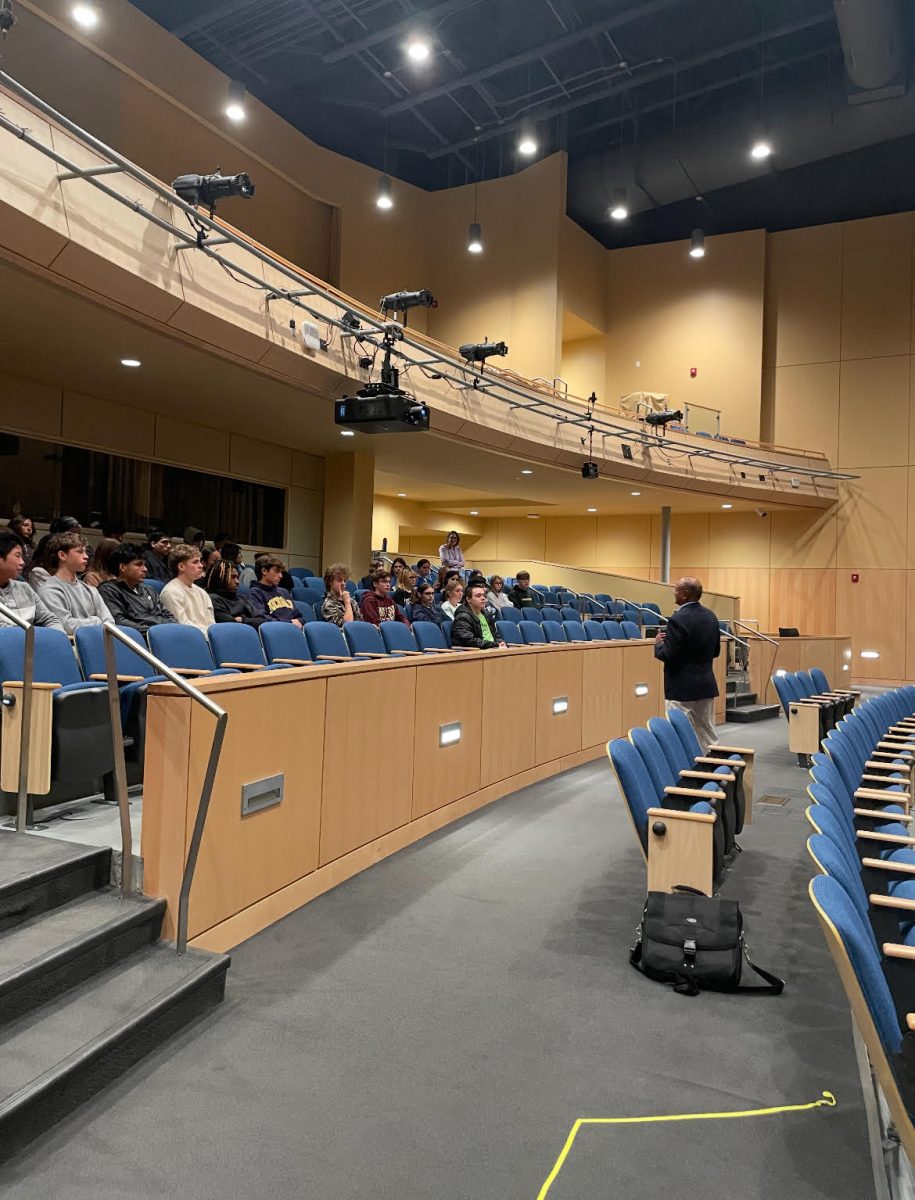
50 students from AP Gov and Civics met E period, November 4th, to hear Federal Judge, Dave Vatti, discuss what hes learned from years of serving in the courtroom and how the government works. He also participated in a Future Path presentation earlier in the day speaking similarly about how he became a judge.
Vatti became a judge on March 22, 2025 and is currently at the U.S Court House in Bridgeport, CT. During the presentation, Vatti explained that he didn’t just start as a judge, there was major work involved. Judge Vatti started in private practice, then became a U.S attorney, working there from 2004 till 2021. While there, he prosecuted violent crimes, drug trafficking, and racketeering.
Outside the courtroom, Judge Vatti created the development of a partnership between schools and court systems called the Career Pathways Collaborative. The program identifies middle schoolers in Connecticut cities who are considered at risk and put them into trade training programs. After they go through their schooling, and graduate with a trade, they eventually work in the specific industry. The overall rate of recidivism, relapsing into criminal activity after being punished for a crime, is 60% nationwide, but with this new program the rate for recidivism dropped to only 2%, according to United States District Court.
His explanation of his journey on how he achieved becoming a judge fascinated students interested in the field. Hernika Singh, a student who attended the in-school field trip explained, “it surprised me how hard it is to be a judge and that whole process. I don’t know if I personally would be interested in being a judge, but he contrasted how different the job fields are from being a lawyer to being a judge.”
For Karyn O’Beirn, who sets up these opportunities and is the administrative assistant who attended the in school field trip, shared, “its valuable to learn about different careers within the law, especially for people who start to think about being a lawyer and in that field.”
 “Meeting the judge strengthened my interest in pursuing law,” said Hernika Singh, a student who attended the in school field trip, “ because he was very inspiring, and I also want to major in political science when I go to undergrad… I thought that related a lot to my focus and my goals,” she explained.
The judge shared a personal story, talking about a time when he presided over a trial and the defendant was accused of murder. One of the questions on the table was whether to pursue the death penalty. This left a lot of students wondering and feeling immediate pressure which choice they would choose. “The question was brain altering,” Singh described.
“He was very well-spoken and answered a lot of my questions that I had beforehand without having to ask them,” Singh said. “He was very informative on the justice system and surprised me how hard it is to be a judge and that whole process.”
Overall, there are 19 judges in the U.S district court for the district of Connecticut. Connecticut District Courts are located in Bridgeport, Hartford, and New Haven.
Mrs. O’beirn shared, “It was a gift having the judge here for both the future path and the in school field trip, he gave our students a new perspective on the justice system and what it means to serve.”