
In the main stairwell of The Morgan School there is a poster telling students to stay off their phones. This post is strangely shaded, and the zombified Morgan husky mascot has thumbs. At a quick glance, the posters look amazing, but upon further inspection, something is clearly wrong. The art on these posters doesn’t look right. The posters lack the emotion that typical pieces of art have, and the school husky has a hand and thumbs instead of a paw.
“The Husky just doesn’t look right. It is so obviously AI-generated,” Rylen Robertson, a musician, artist, and sophomore here at Morgan, pointed out.
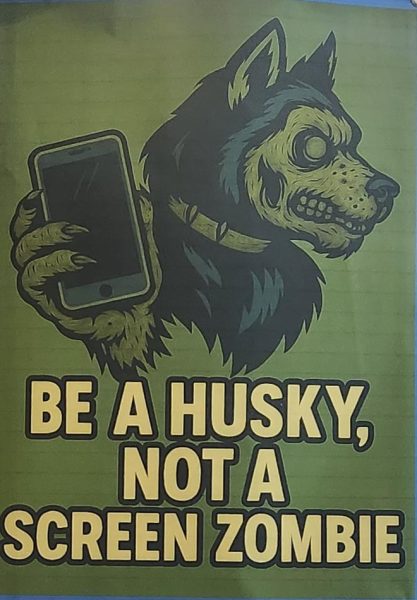
This poster represents a growing trend of using AI in the creative world. “As for just passing the AI-created art off as the finished product, I find that to be problematic,” said Justin Sylvia, the art teacher at The Morgan School. “It’s lacking the human touch. And that’s, you know, what is… one of the great parts of life is just being able to create, being able to express yourself.”
Passing off AI as a finished art project could be seen, and is seen, as problematic. Generative AI has been used in advertisements, political statements, and even sold as drawn artwork. Sylvia mentioned that being able to express yourself through art is a great part of life, and passing AI off as a finished art product is incorrect.
When I asked Sylvia about his opinions on creative students making posters instead of using AI to create them, he said the following. “If it was something that an interested student was willing to make, and then they reached out to the staff member who is runn
ing the program or the club and wanted to create a poster for them. I think that’s wonderful!”
Here at Morgan, we try to encourage student ideas into everyday life, and using something as controversial as generative AI may harm this aspect of school life. Having a student create posters could be an amazing thing to have here, and it could bring forward a very needed aspect of creativity here at The Morgan School. Sylvia had expanded on this idea in our interview, and seemed to be with student creativity.
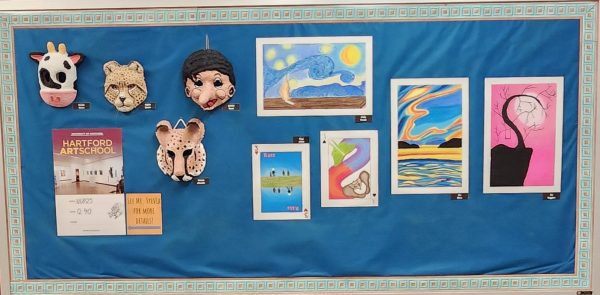
While anything hanging from a wall tends to stick out to most people, there is a very important place in our school wh
ere Morgan students can see student-created artwork. In the lower A wing, right outside Mr Sylvia’s art room, there is a series of bulletin boards where he places students’ art pieces.
“I tend to always look at the art in the hallways as well,” said Robertson. People look at this wall all the time while passing through this
hallway because it has personal style and emotion built into it. Every piece of art looks different depending on who created it, and all these art pieces are a reflection of someone’s mind. “It’s so nice t
o know that the students at Morgan can be so creative and be able to see it in the halls,” said Eloise Racho, another sophomore here at Morgan.
Posters aren’t the only thing that generative AI has changed within our school. Students have turned to generative AI questions to solve real-world problems and complete their homework; however, this can cause horrible repercussions if overused.
A study by Gerlich in 2025 shows how the overuse of AI to solve people’s issues can cause cognitive offloading. While cognitive offloading can be useful when someone needs to think about one thing and one thing only, when someone offloads too often, it can cause severe cognitive impairment.
Julie Frydenborg, an English teacher at The Morgan School, spoke on this idea, “People won’t know how to think critically, they’re gonna make machines do it.”
According to Julie Frydenborg, an English teacher at The Morgan School, generative AI is incorrect a lot of the time. Even though it has gotten better over the years, it can still not be trusted one hundred percent of the time.
Generative AI uses information from all parts of the internet, and because of that, the AI will not filter out the blatant lies that the internet holds. Ms Frydenborg said, “If you aren’t kind of an expert in that topic, you’re gonna think the information is right, and then we all know how the game of telephone goes once the information keeps getting wrong”.